Behind aggregate growth numbers, the U.S. home cleaning market operates through a patchwork of local regulations, fragmented labor pools, and compliance requirements that national forecasts rarely surface. This article measures where the gaps sit between headline growth and operational reality.
Regulatory complexity across U.S. cleaning markets
There is no nationwide U.S. cleaning-business license. Licensing obligations shift depending on the state, county, and sometimes the city where a company operates. Additional requirements can be triggered by the business structure chosen, the chemicals used on-site, waste-handling procedures, or specialized work such as mold remediation and biohazard cleanup.
Recommended read: Boosting profits in 2026: professional marketing services for e-commerce businesses
This creates a compliance landscape that looks nothing like a single market. A cleaning company expanding from Texas to California faces an entirely different set of permits, insurance minimums, and environmental rules. For homeowners hiring a service, it means local verification matters more than brand recognition.
The practical consequence is that many residential cleaning businesses stay regional. Scaling across state lines requires legal reviews and re-registration processes that eat into margins, which partly explains why the industry remains dominated by small operators rather than a handful of national chains.
Read also: Reliability and efficiency: top courier services in the United States
Disinfection claims and EPA compliance: a hidden dividing line
One distinction that separates professional services from casual cleaning operations is how disinfection claims are regulated. In the United States, any product marketed as a disinfectant must generally be registered with the Environmental Protection Agency under federal pesticide rules. The product label controls permitted surfaces, target pathogens, application method, and required wet contact time.
This applies regardless of branding. A company advertising “green” or plant-based cleaning does not escape EPA registration if it claims to disinfect. The label is legally binding, and deviating from its instructions (wrong surface, insufficient contact time) can void effectiveness and create liability.
| Claim type | EPA registration required | Label controls application |
|---|---|---|
| Cleaning (soil removal) | No | No |
| Sanitizing (reduces bacteria) | Yes | Yes |
| Disinfecting (kills pathogens on surfaces) | Yes | Yes, including wet contact time |
Eco-friendly positioning does not remove federal compliance obligations. A professional service that understands this distinction delivers measurably different results from one that simply sprays and wipes. When evaluating a cleaning company, asking whether they follow EPA-registered product labels is a more useful question than asking whether they use “natural” products.
Labor fragmentation and wage gaps in residential cleaning
National growth projections of 6% to 7% annually suggest a uniformly expanding industry. The labor data tells a different story. According to QCEW 2024 data compiled by StartBusinessByState, wages and labor availability vary sharply between U.S. markets. A cleaning business in a high-cost metro faces different hiring economics than one in a mid-size Southern city.
This fragmentation affects service quality directly. In markets where wages are lower and turnover is high, companies struggle to retain trained staff. In higher-wage markets, the cost of labor pushes prices up, which shifts the customer base toward higher-income households or commercial contracts.
- Labor availability determines whether a company can maintain consistent teams or rotates staff frequently, which impacts cleaning quality and client trust.
- Wage disparities across states mean that a “national average price” for home cleaning is misleading for consumers comparing local quotes.
- Dual-income households drive residential demand, but their willingness to pay depends heavily on local cost-of-living dynamics.
The broader cleaning services market, including commercial and industrial segments, is expected to grow from roughly 418.7 billion dollars in 2025 to 823.6 billion dollars by 2035 globally, at a 7% annual rate. Residential cleaning competes for the same labor pool, often at lower wages, which constrains its ability to professionalize.
Professional home cleaning versus DIY: what the data supports
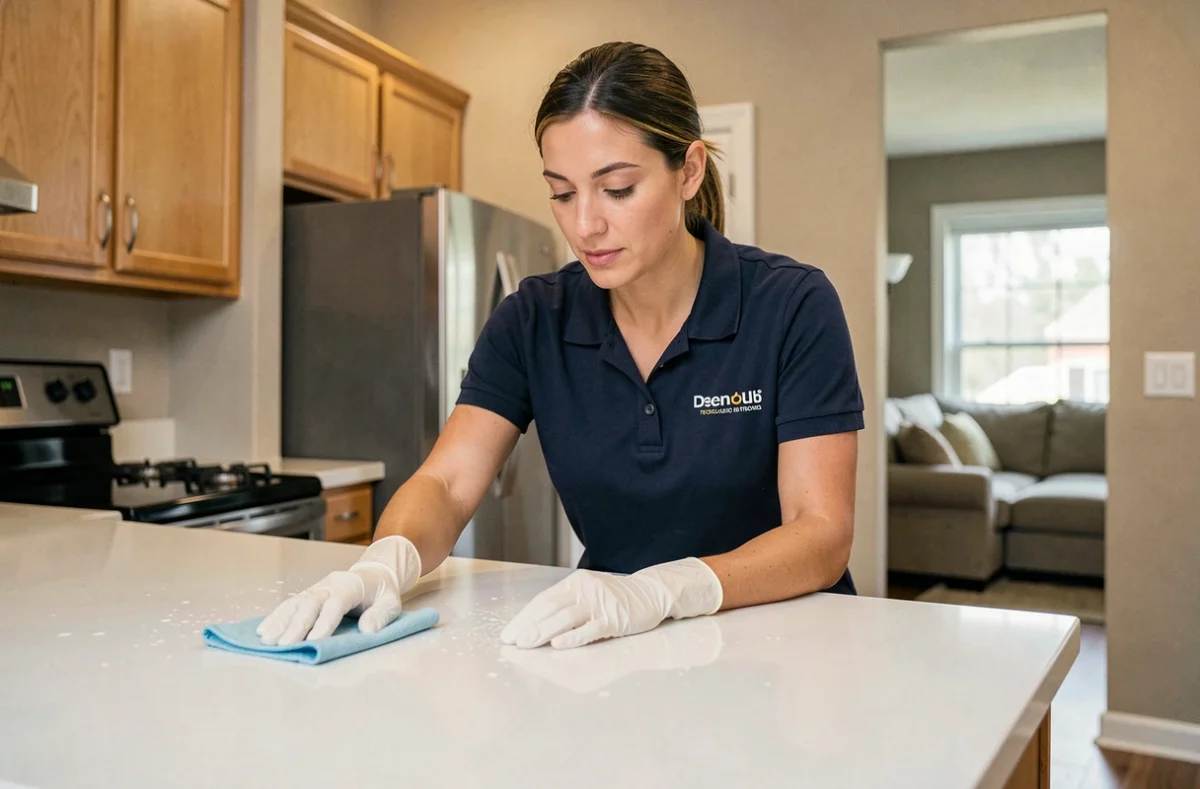
The case for professional cleaning services extends beyond convenience. Proper chemical handling is a genuine safety consideration. Combining incompatible household products can release harmful fumes, making product knowledge a practical safety skill. Professional operators trained on product compatibility and EPA-labeled procedures reduce that risk.
Storage is another overlooked factor. Concentrated cleaning chemicals require specific temperature and ventilation conditions. A professional service manages its own supply chain and storage, removing hazardous materials from the household entirely between visits.
- Professional services using EPA-registered disinfectants follow label-mandated contact times, which most consumers skip during routine cleaning.
- Trained teams apply products to the correct surfaces, avoiding damage to stone countertops, hardwood, or specialty finishes.
- Chemical storage and mixing hazards shift from the homeowner to the service provider, reducing household risk.
- Subscription models, now common among residential providers, create predictable scheduling that maintains baseline hygiene between deep cleans.
The growth of residential cleaning subscriptions reflects a shift in how American households treat home maintenance. Rather than occasional deep cleans, recurring service appointments keep spaces at a consistent standard, which has measurable effects on indoor air quality and surface hygiene over time.
The American home cleaning market is growing, but the gap between market forecasts and ground-level operations remains wide. Consumers comparing services benefit from checking local licensing, asking about EPA-compliant disinfection practices, and understanding that pricing reflects regional labor economics rather than a national benchmark. The companies that thrive through 2035 will likely be those that solve the labor retention problem while maintaining regulatory compliance across every market they serve.