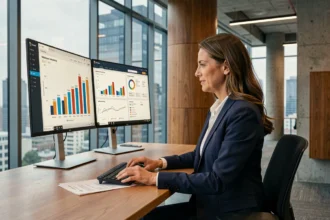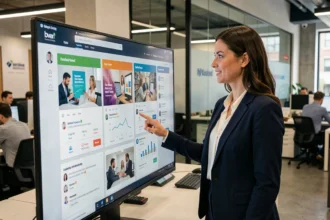


When Owl Labs released its 2026 State of Hybrid Work Report, one data point stood out: nearly half of surveyed employees admitted to practicing “Billboard Days,” picking their in-office days specifically to be seen by executives or clients. That single behavior tells us more about the state of American workspaces than any corporate memo about collaboration.
Remote work culture in 2026 is not settling into a comfortable equilibrium. It is being shaped by a tug-of-war between visibility politics, AI tooling, and legal pressure that most trend roundups skip over.
Further reading: Cybersecurity threats in 2026: Navigating the digital landscape
Billboard Days and presence theater in hybrid offices
The concept is simple. An employee checks the calendar, sees which days the VP or a key client will be on-site, and books a desk for that day. The work itself could happen anywhere, but the point is to be physically visible. Owl Labs calls this “presence theater,” and it is reshaping office attendance patterns.
This creates a practical problem for facilities teams. Foot traffic spikes on certain days, leaving offices half-empty the rest of the week. Companies that invested in redesigned collaboration spaces find those spaces overloaded on Tuesdays and Wednesdays, then deserted on Fridays. The workspace was built for steady use, but the incentive structure rewards strategic appearances.
Related reading: Electric vehicles revolution: American automakers driving towards a green future
For managers, the signal is unreliable. High office attendance no longer means high collaboration. It can just as easily mean employees are optimizing for face time. Any return-to-office policy that measures success by badge swipes alone is measuring the wrong thing.

AI tool adoption and the workspace governance gap
Here is a scenario playing out in offices right now. A marketing analyst sits at a shared desk, plugs in a laptop, and uses an unsanctioned AI tool to draft a competitive analysis. The document includes proprietary pricing data. That data now lives on a third-party server, processed through a model the company never vetted.
The Owl Labs 2026 report flags this directly: AI adoption is outpacing corporate governance policies. Companies redesigning physical offices around collaboration zones are simultaneously ignoring a digital problem that happens in those very spaces. When employees come to the office to work side by side, they bring their personal AI workflows with them.
This intersection of physical presence and digital tool use raises questions that most workspace strategies do not address:
- Which AI tools are employees using on company networks, and has IT approved them for handling confidential data?
- Do collaboration zones with shared screens increase the risk of exposing proprietary information processed through unvetted AI platforms?
- Is the company’s acceptable-use policy updated to cover generative AI, or does it still reference only cloud storage and personal devices?
We are not talking about a hypothetical risk. Workspace design and data governance now overlap, and companies treating them as separate projects are leaving a gap.
ADA accommodation conflicts and remote work requests
Return-to-office mandates are running into a legal constraint that gets less attention than it deserves. Employees with disabilities who successfully worked remotely for years are now being told to return, and many are pushing back through Americans with Disabilities Act accommodation requests.
The friction is real. An employer argues that in-person presence is now an “essential function” of the role. The employee points to three years of documented remote performance. Courts and the EEOC are actively working through these cases, and the outcomes vary depending on how well the employer documented the business necessity of on-site work before issuing the mandate.
Companies that skipped the documentation step are exposed. If a role was performed remotely without issue for an extended period, claiming that physical presence is suddenly required demands a strong, specific justification. “Culture” and “collaboration” may not be enough if the employee’s actual tasks never required a physical workspace.
This matters for workspace planning because it changes who is in the office and on what terms. Facilities teams may need to accommodate a patchwork of schedules, with some employees fully remote by legal right and others on a hybrid rotation. Designing a workspace around uniform attendance is becoming less realistic.
Multi-state tax compliance for distributed teams
A less visible but operationally painful aspect of remote work culture in 2026 involves state tax rules. When an employee works from a different state than the company’s office, both the employee and the employer may face filing obligations in multiple jurisdictions.
Some states apply an “economic nexus” standard, taxing income based on where the work is performed. Others follow a “physical presence” standard. State-level tax rules for remote employees are still evolving, and for companies with distributed teams across several states, this creates a compliance burden that scales with every new hire’s zip code.
The practical impact on workspace strategy is indirect but real. Some companies are responding by encouraging (or mandating) that remote employees work from states where the company already has a tax presence. Others are limiting hiring to specific geographies. In both cases, the “work from anywhere” promise gets quietly trimmed by payroll and legal teams operating behind the scenes.
What this means for workspace budgets
Every new state where an employee works can trigger registration, withholding, and reporting requirements. Companies that once spent their facilities budget on square footage are now allocating part of it to tax compliance software and multi-state payroll services. The workspace, in other words, is no longer just a physical place. It is also a tax footprint.

Return-to-office mandates versus measured productivity
WorkTime’s 2026 return-to-office statistics highlight a disconnect: employers are adding office requirements even though a majority of remote-capable employees still prefer hybrid arrangements. The mandates are not primarily driven by productivity data. They are driven by managerial preference for visibility and control.
This does not mean offices are useless. Certain tasks (onboarding, brainstorming, conflict resolution) benefit from shared physical space. The problem is that most RTO mandates do not distinguish between tasks that need presence and tasks that do not. A blanket three-days-a-week policy treats a software engineer debugging code the same as a sales team running a client workshop.
Companies getting workspace redesign right in 2026 tend to share a few traits:
- They tie office days to specific activities (sprint planning, client meetings, team retrospectives) rather than a fixed weekly count.
- They measure output and project milestones instead of badge swipe frequency.
- They actively survey employees about which in-office experiences add value, then adjust the space accordingly.
The gap between what employees want and what executives mandate is not closing on its own. The companies bridging it are the ones treating workspace design as an ongoing operational decision, not a one-time real estate play.
Remote work culture in American companies is not a settled question. Between presence theater, AI governance blind spots, ADA legal exposure, and multi-state tax headaches, the workspace of 2026 is a moving target. The organizations adapting fastest are the ones treating flexibility as a system to manage, not a perk to revoke.